
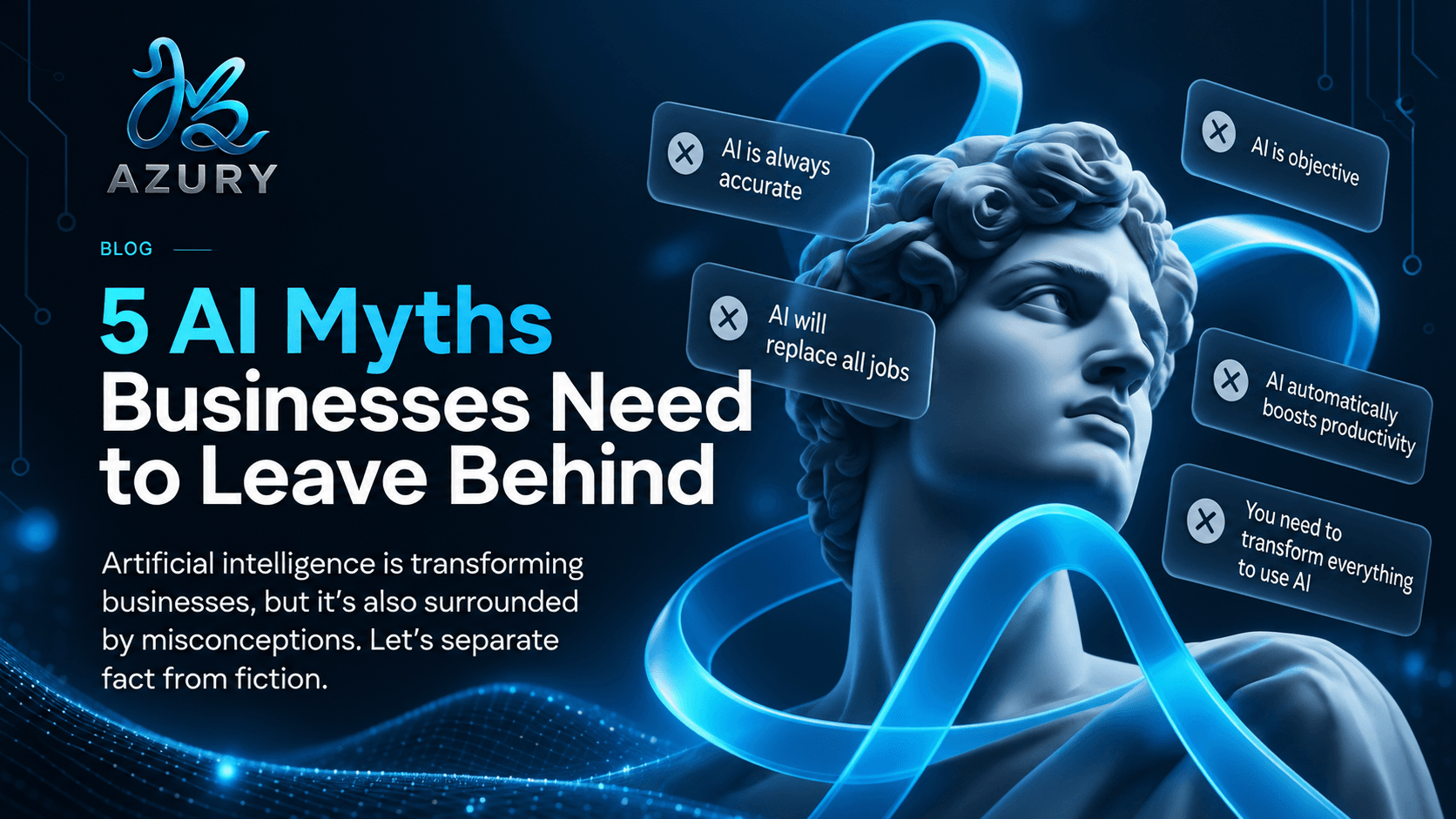
Artificial intelligence is no longer a technology reserved for research labs and major technology companies.
Today, AI can draft documents, analyze information, generate code, assist customers, automate workflows, and support decision-making across nearly every area of a business.
Adoption is also accelerating rapidly. According to the **Stanford AI Index Report 2026**, 88% of surveyed organizations reported using artificial intelligence in at least one business function during 2025, while generative AI was already being used by 70% of organizations.
However, the more popular a technology becomes, the easier it is for exaggerated claims to spread around it.
Some portray AI as an infallible digital employee.
Others suggest it will eliminate nearly every job.
And some businesses assume that simply purchasing an AI platform will automatically increase productivity.
The reality is far less cinematic.
Artificial intelligence has extraordinary capabilities, but it also has important limitations. Understanding both is essential for using it effectively.
Here are five AI myths businesses should start leaving behind.
1. “If AI Sounds Confident, It Must Be Correct”
One of the most common mistakes when using generative AI is confusing **fluency with accuracy**.
Large language models are designed to generate coherent responses based on patterns learned from massive amounts of information.
That allows them to produce remarkably convincing content.
The problem is that a convincing answer is not necessarily a correct one.
AI systems can generate what are commonly known as **hallucinations**: incorrect facts, fabricated references, inaccurate dates, or explanations that sound reasonable but are simply false.
This has important implications for businesses.
AI can be extremely useful for:
- summarizing large amounts of information;
- creating first drafts;
- classifying documents;
- identifying patterns;
- generating ideas;
- automating repetitive tasks.
However, when AI-generated output affects financial, legal, commercial, healthcare, or security decisions, human oversight remains essential.
The right strategy is not to **trust AI blindly**, but to design workflows where its output can be reviewed and verified.
2. “AI Is Objective Because It Uses Data”
Algorithms do not exist in a vacuum.
Artificial intelligence systems are trained using information created by people, institutions, and organizations.
That information may contain errors, historical inequalities, cultural biases, or incomplete representations of certain groups.
And data is only part of the equation.
A system's behavior can also be influenced by:
- its underlying architecture;
- the instructions it receives;
- the criteria used to evaluate it;
- the data provided by the organization;
- the context in which it is deployed.
For that reason, using artificial intelligence does not automatically remove subjectivity from decision-making.
In some cases, it can even amplify existing problems.
Consider, for example, an AI system used to evaluate job candidates.
If the historical data used to build or train the system reflects certain hiring patterns, the model may reproduce those same patterns without decision-makers immediately realizing it.
That is why organizations integrating AI into important processes need **auditing, human oversight, and strong data governance**.
The question should not simply be:
“What does the AI recommend?”
Businesses should also ask:
“What information led to this result, and how can we verify it?”
## 3. “AI Will Eliminate Every Job”
This is probably one of the most repeated claims about artificial intelligence.
It is also one of the most oversimplified.
Evidence available through 2026 points to a much more complex transformation.
Research from Stanford's Digital Economy Lab has not found evidence of widespread worker displacement across the entire economy caused by artificial intelligence.
However, researchers are identifying effects within certain occupations and demographic groups, particularly among younger workers in highly automatable roles.
More recent research using data from dozens of countries also suggests changes in how companies structure their workforce, especially across junior and senior positions.
This means the most useful question is not simply:
“Will AI replace jobs?”
A better question is:
“Which tasks within each job can AI automate or transform?”
That distinction matters.
A software developer can use AI to generate and review code faster.
A marketing specialist can create campaign variations and analyze data more efficiently.
A customer service team can automate common requests while reserving complex cases for human agents.
An administrative department can automate document classification, data entry, and processing.
In many situations, the entire role does not disappear.
Instead, **the combination of tasks that makes up the role changes**.
That does not mean there are no labor-market risks.
Some roles may disappear, others may experience lower demand, and many will require new skills.
Entry-level positions may be particularly affected because many of the repetitive tasks traditionally used to train junior employees can now be automated.
Businesses therefore need to think beyond efficiency.
They also need to consider **reskilling, training, and job redesign**.
4. “Implementing AI Automatically Improves Productivity”
Buying an artificial intelligence tool is easy.
Transforming an organization with artificial intelligence is something else entirely.
Research included in the Stanford AI Index shows that productivity gains vary significantly depending on the task.
AI tends to generate stronger results in activities that are structured, measurable, and have clear criteria for evaluating output quality.
But that does not mean every process improves simply because AI is added to it.
In fact, recent studies point to an interesting paradox.
AI adoption is growing rapidly, yet many companies still struggle to turn those investments into meaningful improvements in performance.
The problem is often not the technology itself.
It is the implementation.
A company can purchase multiple AI platforms and still see little value if:
- its processes are poorly defined;
- its data is fragmented;
- employees do not know how to use the tools;
- there are no clear performance metrics;
- inefficient workflows are automated before being simplified;
- each department adopts AI tools without coordination.
The real opportunity appears when companies identify **specific processes where artificial intelligence can generate measurable value**.
For example:
reducing the time required to process requests,
eliminating repetitive manual tasks,
improving customer service,
accelerating software development,
analyzing information faster,
or allowing employees to spend more time on strategic work.
AI does not automatically turn a bad process into an efficient one.
Sometimes it simply allows a company to execute the same bad process much faster.
5. “A Company Must Transform Everything to Start Using AI”
Technology enthusiasm can lead to another mistake: assuming that businesses need a massive transformation initiative before they can start using artificial intelligence.
In reality, some of the most effective implementations begin with much smaller, clearly defined problems.
Organizations can start by identifying tasks with characteristics such as:
- high volume;
- repetitive workflows;
- relatively clear rules;
- large amounts of digital information;
- significant manual effort;
- measurable outcomes.
From there, companies can implement a limited solution, measure the results, and gradually expand its scope.
This approach allows teams to answer critical questions before scaling:
Does the automation actually save time?
Is the output accurate enough?
What types of errors appear?
Where is human oversight still necessary?
What information does the system require?
Is there a measurable return on investment?
Effective AI adoption is not about implementing technology simply because everyone else is doing it.
It is about identifying **business problems where the technology genuinely makes sense**.
The Real Challenge Is Not Adopting AI. It Is Knowing Where to Use It.
Over the next several years, artificial intelligence systems will continue becoming more capable and more deeply integrated into the tools companies already use.
But the organizations that generate the most value from AI will probably not be the ones using the largest number of tools.
They will be the ones capable of distinguishing between what artificial intelligence **can do**, what it **should do**, and what still requires human expertise, judgment, and accountability.
The conversation around AI is moving beyond experimentation.
Now comes the more important stage: turning the technology into measurable business results.
For companies, that means analyzing processes, preparing data, establishing governance, maintaining human oversight, and carefully selecting where automation can create value.
Because the competitive advantage will not come from simply **using artificial intelligence**.
It will come from **using it better**.
Is Your Business Ready to Integrate Artificial Intelligence?
At Azury Labs LLC, we help organizations develop technology solutions, automate business processes, and integrate artificial intelligence around real operational needs.
From intelligent automation and enterprise platforms to custom software development and AI-powered solutions, the objective remains the same:
use technology to solve real problems and create measurable business value.
Discover how Azury Labs LLC can help turn artificial intelligence from an idea into a practical, scalable solution.
---
### Sources
- Stanford University, *AI Index Report 2026*.
- Stanford Digital Economy Lab, research on artificial intelligence and employment, 2026.
- Stanford Institute for Economic Policy Research, analysis of AI, productivity, and labor markets, 2026.
- IBM, research and documentation on artificial intelligence hallucinations.
- McKinsey & Company, research on enterprise AI adoption and value creation, 2026.