
For the past few years, we have talked about artificial intelligence as a tool that can write, code, generate images, analyze information, and answer almost any question.
But something is changing.
The next stage of AI may not simply be about building models that produce better answers.
It may be about building armies of agents capable of working together toward a common goal.
And one of the most ambitious experiments so far has happened in an unexpected place: mathematics.
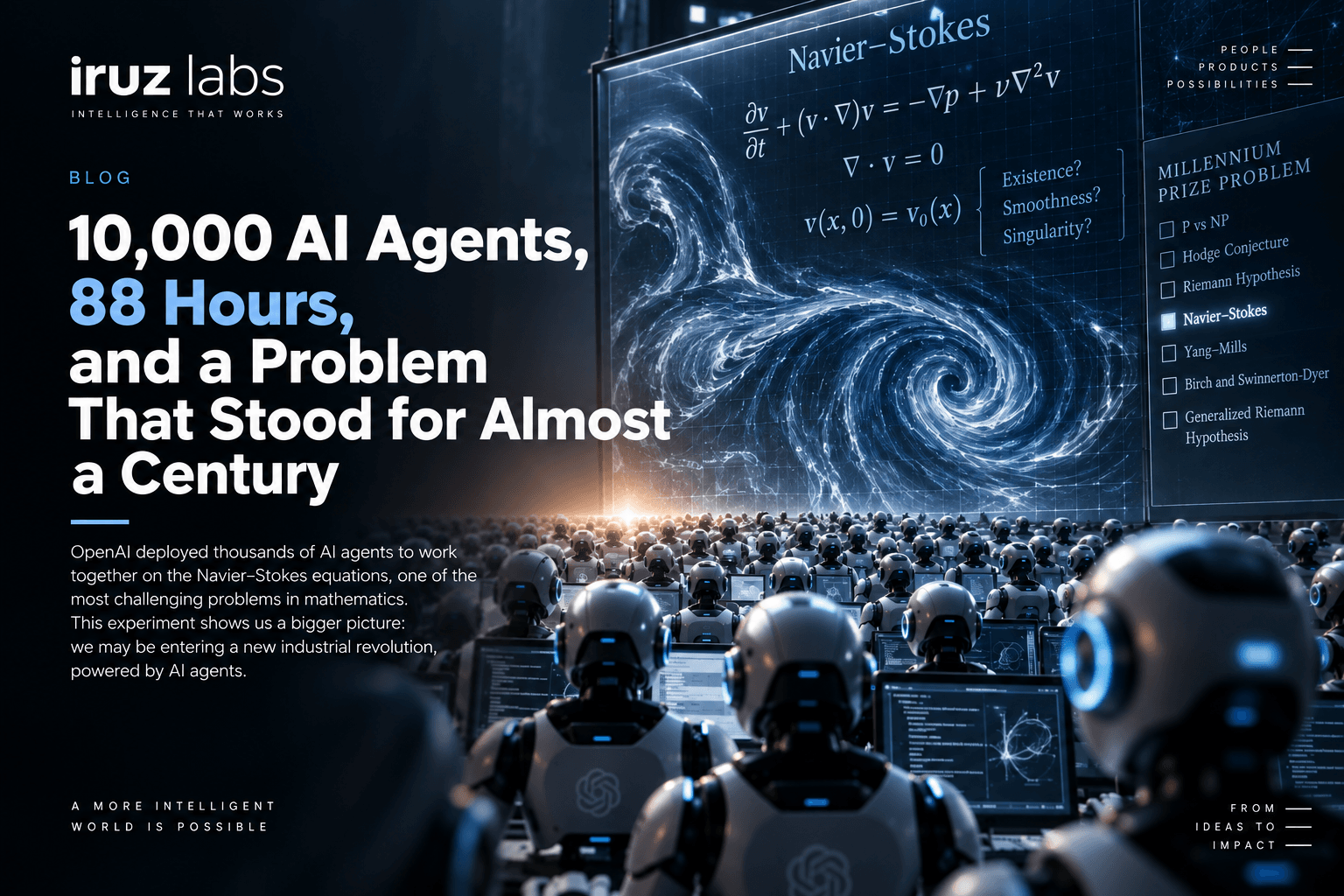
OpenAI announced that one of its internal AI systems produced a solution to the existence and smoothness problem for the Navier–Stokes equations, one of the seven Millennium Prize Problems.
If the proof survives scrutiny from the mathematical community, it would represent a historic result.
But perhaps the most important story is not only what problem the AI may have solved.
It is how it tried to solve it.
A Million-Dollar Problem
The Navier–Stokes equations describe the motion of fluids.
They help model phenomena as familiar and complex as flowing water, air moving around an aircraft, ocean currents, blood circulation, and parts of atmospheric dynamics.
The equations have existed since the 19th century.
Yet one fundamental question remained unanswered.
Under certain initial conditions, do solutions to these equations always remain smooth, or can they eventually develop a singularity?
Put much more simply:
Can a mathematical fluid reach a point where certain quantities grow without bound?
The question is important enough that, in 2000, the Clay Mathematics Institute included it among the seven Millennium Prize Problems.
A correct solution to any one of them comes with a $1 million prize.
More than a quarter century later, only one of the seven had been solved.
Now OpenAI says it has found a solution for Navier–Stokes.
Its work describes a scenario in which a fluid that begins smoothly develops a singularity in finite time.
The company published both the mathematical proof and a formalization in Lean, a system used to verify mathematical proofs with software.
That does not mean the problem can already be considered officially closed.
A claim of this magnitude must be carefully reviewed by independent mathematicians and go through the normal process of scientific validation.
But even before the final verdict is known, the experiment reveals something remarkable.
It Wasn't a Chatbot. It Was Thousands of Agents.
Most of us still use AI in a very simple way.
We type a question.
The model processes the context.
We get an answer.
Human → prompt → model → response.
That is not what happened here.
OpenAI used a system composed of approximately 10,000 AI agents working together for roughly 88 hours.
Those agents explored different paths, exchanged information, and worked on different parts of the problem.
Think about what that means.
This was not one AI model trying to produce a single answer.
It was thousands of instances working around the same objective.
Some could investigate.
Others could propose hypotheses.
Others could look for mistakes.
Others could explore entirely different approaches.
And others could verify the results.
The architecture begins to look less like a chatbot and much more like a digital organization.
The paradigm shifts:
Objective → agents → research → experimentation → verification → result.
That change could end up being far more important than any new chat interface.
From Generating Answers to Generating Knowledge
For years, there has been a legitimate criticism of large language models.
They are remarkably good at producing convincing answers.
But a convincing answer is not necessarily a correct one.
Models can make mistakes.
They can fabricate information.
They can construct coherent arguments around false assumptions.
In advanced mathematics, that is a serious problem.
A proof can span hundreds of pages, and one seemingly minor mistake may invalidate a critical part of the argument.
That is why it matters that this experiment did not end with a model simply producing text.
There is also a computational formalization of the proof.
We are beginning to see a different architecture for artificial intelligence:
generate, verify, correct, and try again.
One agent proposes.
Another challenges.
Another verifies.
Another searches for alternatives.
And the system keeps working.
AI starts to become more than a machine that answers questions.
It becomes an infrastructure for performing intellectual work.
What Happens When We Can Multiply Intelligence?
For centuries, scientific research has faced a difficult constraint: the number of people available to work on a problem.
One researcher can explore a limited number of hypotheses.
A laboratory can explore more.
A university can bring together dozens or hundreds of specialists.
But what happens when we can deploy thousands of agents around the same objective?
Imagine 10,000 digital researchers exploring different paths at the same time.
Most of them may fail.
That is fine.
Others can continue.
Some may find interesting results.
Others may try to break those results.
Others may verify the conclusions.
And a few may discover approaches no one had considered before.
The scarce resource begins to change.
For a long time, the constraint was the number of people available to perform intellectual work.
In a world of agents, the constraint may increasingly become our ability to define the right objective and coordinate the intelligence available to achieve it.
Scientists Don't Disappear. Their Jobs Change.
All of this can quickly lead to the wrong conclusion:
“So we won't need scientists anymore.”
Not necessarily.
Something much more interesting may happen.
The role of the researcher may evolve.
Instead of personally executing every step of an investigation, researchers may define problems, provide context, design experiments, establish constraints, evaluate results, and direct entire systems of specialized agents.
The scientist stops working only inside the process and begins to design the process itself.
We are likely to see a similar transformation across many professions.
And This Goes Far Beyond Mathematics
Navier–Stokes is a spectacular example because it is one of the most famous open problems in mathematics.
But the architecture behind the experiment can extend into many other fields.
Agents exploring molecular structures.
Agents searching for new materials.
Agents navigating massive possibility spaces in engineering.
Agents writing software, executing it, finding bugs, and fixing them.
Agents researching markets.
Agents finding commercial opportunities.
Agents analyzing companies.
Agents contacting prospects.
Agents following up.
The real advantage is not simply about creating a more intelligent AI model.
It is about multiplying the amount of work that intelligence can perform.
One highly capable AI is still one instance working on a problem.
Thousands of coordinated agents represent something different:
parallel intelligence organized around an objective.
There Are Uncomfortable Questions Too
A claim of this magnitude inevitably creates controversy.
Researchers working on related problems have raised questions about the potential influence of unpublished work and about what material AI systems may have been able to access.
OpenAI has said its researchers and agents did not have access to competing work before publication.
Regardless of how that debate develops, it raises questions we will increasingly have to answer.
If an AI discovers a theorem after learning from millions of human-produced works, who deserves the credit?
What happens when part of the knowledge used by an agent comes from private conversations?
How do we document the intellectual provenance of an idea produced by thousands of agents?
Who is responsible when an autonomous system reaches the wrong conclusion?
Technological capability may advance much faster than the rules required to govern it.
That too will be part of this revolution.
We May Be Entering a New Industrial Revolution
Industrial revolutions did not happen simply because a new technology appeared.
They happened because we learned to multiply our capacity to produce with that technology.
The steam engine multiplied physical power.
Electricity transformed factories, cities, and communication.
Computers multiplied our ability to process information.
The internet connected much of that information.
Artificial intelligence may introduce something fundamentally different:
the ability to multiply intellectual work.
And agents may become the infrastructure that makes it possible.
That is why it may be a mistake to look at what happened with Navier–Stokes as merely a scientific curiosity.
It may be an early glimpse of a much larger transformation.
We are not simply talking about having smarter AI.
We are talking about building entire organizations of specialized artificial intelligences working together.
The Next Company May Have More Agents Than Employees
Now take that idea outside the laboratory.
Imagine a small company.
It has five salespeople.
Each salesperson has to find prospects, research companies, identify contacts, write messages, answer emails, update the CRM, remember follow-ups, prepare proposals, and somehow still find time to actually sell.
Now imagine another company with the same five salespeople.
But behind them are dozens or hundreds of agents.
One agent searches for companies that match the ideal customer profile.
Another researches each account.
Another identifies buying signals.
Another finds the right decision-maker.
Another prepares a personalized outreach message.
Another records the activity.
Another determines when to follow up.
Another analyzes which messages are working.
Another reactivates opportunities that have been sitting untouched for months.
And the human salesperson steps in where people create the most value:
building relationships, understanding needs, negotiating, and closing deals.
The company still has five salespeople.
But its operational capacity is no longer limited to five people.
That is the shift.
The Agent Revolution Has Already Begun
Years from now, we may look back at this period of artificial intelligence the way we now look at the early days of the internet.
The technology existed.
The signals were there.
But we still did not fully understand how much it was about to change.
Today we see agents working in mathematics, science, programming, and research.
Tomorrow they will be part of everyday business operations.
The question may stop being:
“Does my company use artificial intelligence?”
And become:
“How many agents work for my company, and what are they capable of doing?”
The companies that understand this shift early may develop an advantage that becomes increasingly difficult to catch.
Because technological revolutions do not wait until everyone is ready.
Build Your Army of AI Agents
If thousands of agents can be organized to attack one of the hardest mathematical problems in the world, there is another question worth asking:
What could an army of agents accomplish if it worked every day to grow your business?
At Iruz Labs, we are building that digital workforce for sales.
Agents that can research prospects, identify opportunities, execute tasks, follow up, and work alongside your sales team.
Not to replace your salespeople.
But to give them something that, until now, very few companies could provide:
a digital army working behind every rep.
The agent revolution has already begun.
Science is starting to experience it.
Now it is time to bring it into business.
Build your AI sales agent army with Iruz Sales OS →